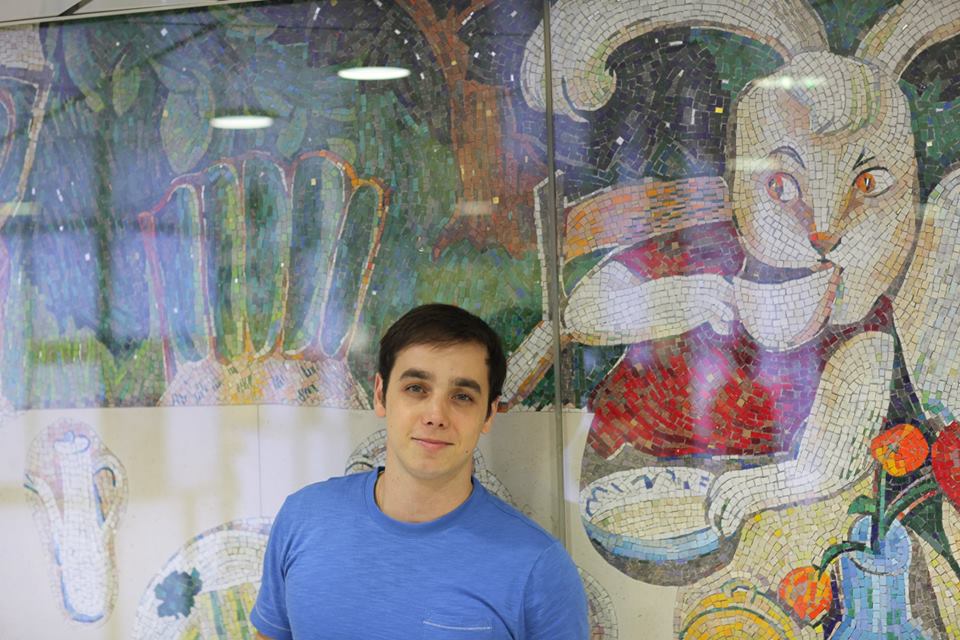
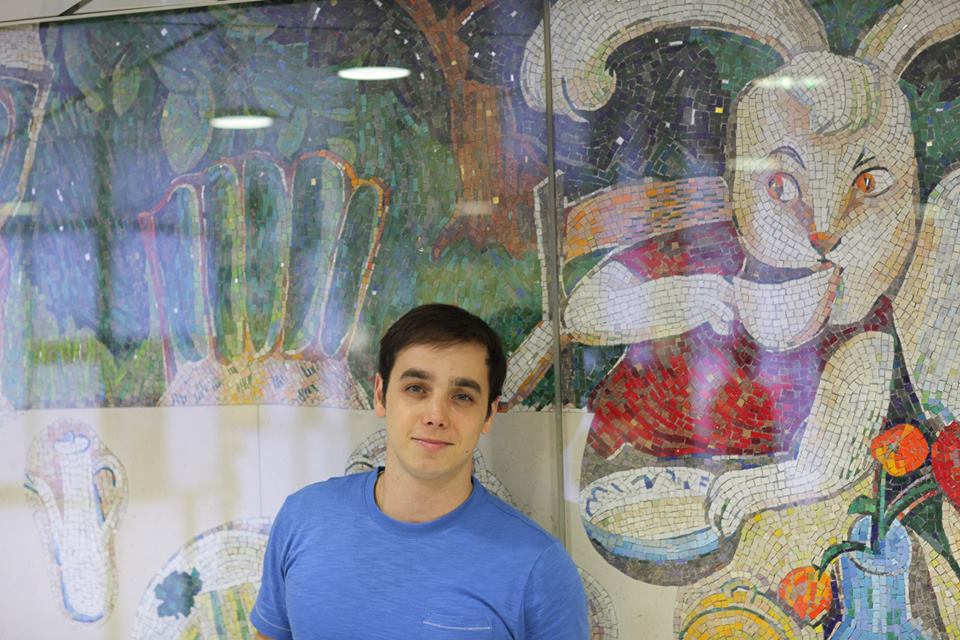
Marcel moved to Japan from Sao Paulo, now works for a Japanese company. Though he longed to live abroad since he was a University student, Marcel says his promising career path was holding him back. With one major life change came another, Marcel made the decision to move abroad.
Profile
Name: Marcel Ferragi Age: 35
He was born in Sao Paulo but, spent most of his teenage years in Peru. After graduating from the University of Sao Paulo, he worked in investment banking and a financial consulting company. In April 2014, he moved to Tokyo as a Japanese Government (Monbukagakusho) Scholarships recipient and went to Keio University for his Master’s degree. Now he works for a Japanese company in Tokyo.
Reality held him back from living abroad
—————Did you think about living abroad when you were in University?
Marcel: Back then I had so many friends who studied abroad and I always wanted to go abroad as well. However, when I was younger, the cost of the decision to leave Brazil was too high.
I was studying at one of the best universities in Brazil and I thought if I freeze one year, I would never finish it. Plus I was doing an internship and they were offering me an opportunity to learn to become a bank manager at a young age. My life was too good to leave.
Then I started working in Brazil. I can’t tell you how many times I tried to become an expat. Sadly the company did not want me to leave because I was doing so well where I was.
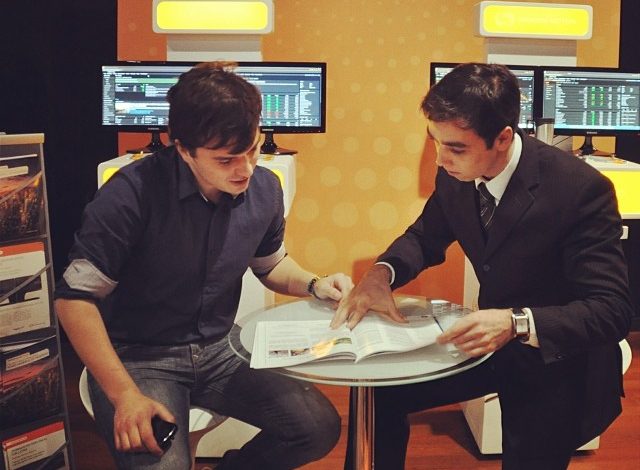 Marcel searched for an opportunity to be an expat while working in Brazil
Incident that changed his life
—————When and how did you make up your mind to come to Japan?
Marcel: I had an incident that changed my personal life.
I had a fiancé back in Brazil. We were together for 4 years. He had a stroke and my life changed completely. I would take care of him for 11months after the accident but then he broke up with me. He wanted to set me free.
After 6 months after the break up, I applied for the Monbukagakusyo Scholarship. If the incident had not happened and the relationship had continued, I may not have moved into action toward living abroad.
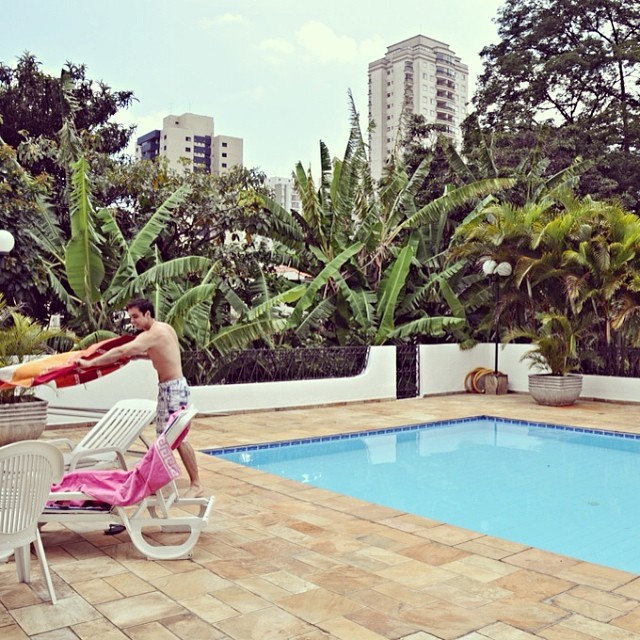
Chilling out by the pool is his regular weekend relaxation
—————How did you know about the scholarship?
Marcel: I knew of it because my brother was once a recipient. I visited him in Japan in 2008. I really liked the country. So I thought if I got the scholarship, I would go for it.
I knew then and there that there was no chance to be an expat at my company and money was not the most important thing for me in life.
—————Did you apply for other scholarships as well?
Marcel: No I didn’t. I could not do it because I was too tired. There was the break up and I had a job. I was tired of everything. So when people ask me why I chose Japan, I say that Japan chose me. Because that was my only shot and I was chosen to come here.
Applying for Scholarship in Japan
—————What was the process like to be a recipient?
Marcel: The program had a 1-year selection. Exam after exam, and at one point there was an interview in the Japanese consulate, with 6 or 7 Old men. They stare at you and judging you! It was so scary.
For the interview with the old men, I had a tip from my brother who got the scholarship years ago, at the end, I said “ Oh, to add one more thing, Gambarimasu (I will work hard)”. Everyone seemed delighted like “Oh! Gambatte! (Work hard)”. That shows that I understand the philosophy right?
—————How many did they pick?
Marcel: 10 out of about 300 candidates. So it was competitive, but actually my university was much harder to get into.
I think that the fact that I studied in the University of Sao Paulo, one of Brazils’ top universities, helped me get the scholarship as well. The fact that I studied in Keio University, one of Japans’ top universities, shows that life is full of consequence.
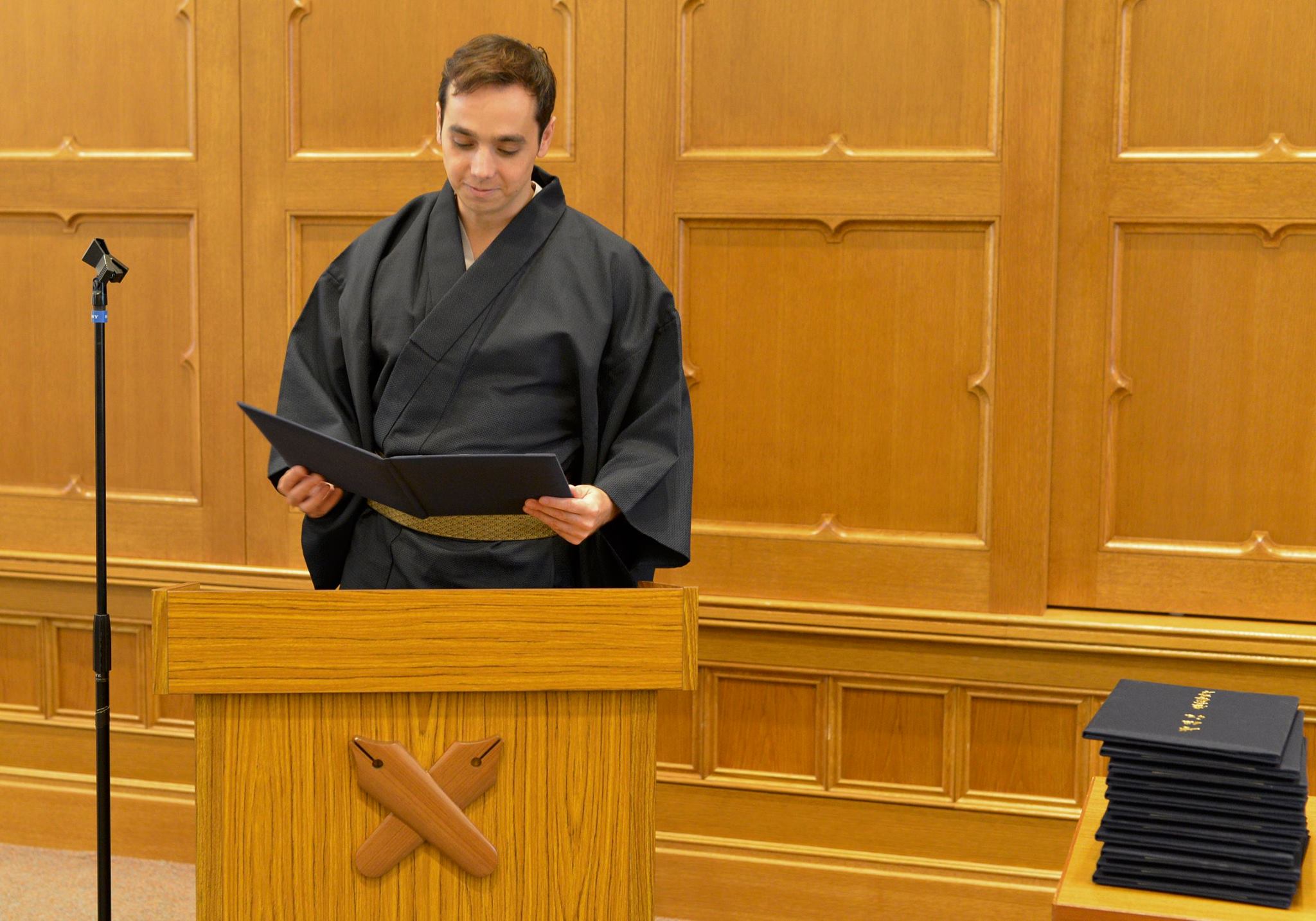 Marcel received Master’s degree and graduated from Keio University in 2017.
Living abroad as a child
—————You spent your childhood abroad right?
Marcel: Yes, I spent most of my teenage abroad in Peru. Before that I lived in many different places in Brazil like Brasilia, Campinas and so on. Our family was always moving for our father’s job. From kindergarten to high school, I went to 13 different schools.
In Peru, I went to an American school and a British one. Most of the students were rich Peruvians. They were not middle class but rather, they were very rich, so many of the kids were very spoiled.
At the British school, I had a very hard time getting along with the other students and I went through a lot of bullying.
—————In Peru, do people recognize you as a Brazilian?
Marcel: Yes, they recognize me as a Brazilian, which puts me in a good position. It makes me look cooler, more sophisticated. You can date cool girls because you are Brazilian.
Also they expect you to play soccer very well. I think that is one of the reasons I did not do well at first. I was not so good at football. That said I was good at hitting on all the nice girls. That time I became more aware of where I come from.
Self discovery in Japan
—————Has living in Japan too changed your perception about yourself?
Marcel: Back then I didn’t think that I was so Brazilian but, when I moved to Japan I realized how Catholic I was.
Take the concept of forgiveness. In Japan, you have the rules and if you don’t follow them, you pay the price. For example, once you miss a deadline, you don’t have a second chance.
In Brazil, it is more about forgiveness. If you forgive someone, it is something noble. You can always say sorry, and you will be forgiven. So that way, I realized how Catholic I was although I don’t follow the religion.
—————What sort of expectation did you have about Japan before you came here?
Marcel: One of the keys to happiness is that you don’t have expectations. I had very low expectations. I was very relaxed and came with an open heart.
Instead, I had three goals that were all tangible. First, I wanted to get my Master’s degree. Second, I wanted to visit countries throughout Asia. Third, I wanted English to be my second language. Back then Spanish was my second.
—————How are you doing with those goals?
Marcel: I achieved them all and I would say I got much more. Now I have a fiancé who is handsome, intelligent, strong and successful and I got a job. I have friends from all over the world. It is amazing!
Although I feel like I am a child most of the time. I am struggling with the language and expressing even the small things. In Brazil, I felt strong in the society. Here everyday I am learning new things that are basic for you. So sometimes it is so tiring.
Accepting to Play Gaijin card
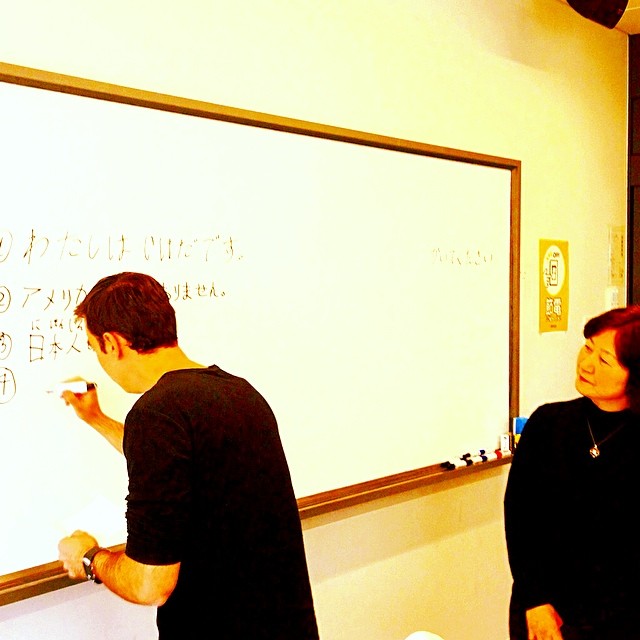
Japanese classs at Keio University
—————What about being Brazilian in Japan?
Marcel: I think that I am very welcomed here, because of my personality and my stereotype. There is a white privilege here, being a Caucasian male.
It is not only in Japan though. I think Japanese people treat me as a European because I look like one and they are open to connect.
My friends from Asian countries complain that it is very difficult to make Japanese friends. If I had the exact same personality but with different physical appearance, it would have been harder.
Also Japan is a very tricky society for foreigners. It is very different from being a foreigner in say Canada or in Australia.
I have friends from Europe, they have been in Japan for ages and speak fluent Japanese, but people still treat them as ignorant Gaijin (foreigner). So I am trying to learn to accept and to play the Gaijin card as needed.
Perception about Brazil
—————After 3 and a half years in Japan, has your perception of your own country been changed?
Marcel: Being in the Japanese society that is so well organized, I think now some parts of Brazil are so disorganized. From transportation to the health care system, in Brazil, it is a mess. Japan is like a machine society.
The thing that I like about Brazil, is that people are happy in Brazil. We have many problems and many things to complain about, but we are happy and we enjoy life.
The Japanese people, they have everything but they are very hard on each other. There is a lot of pressure and passive aggressiveness, which makes the people so sad.
Maybe that’s why we don’t develop as much in Brazil though, because we are relaxed.
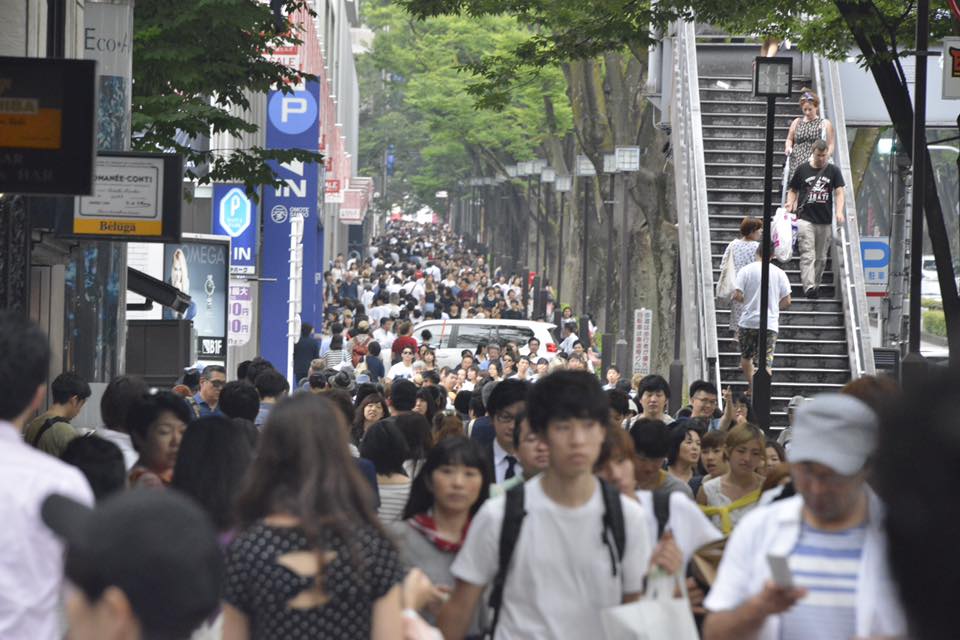 Crowded Omotesando area on a weekend.[/caption]
—————Are there things that you think could be better here?
Marcel: In Japan, people avoid conflict a lot here. People play Tatemae (Public face) rather than telling the truth and have a conflict, because it is easier and they want to protect themselves.
Sometimes conflicts are necessary to solve problems and to improve the situation. So I have many foreign friends who say that Japanese people have a knife behind them at all times.
Having only 3 years of experience here, I think I am not so good at noticing it. So here is my solution. I believe that they are honest. That’s it. I would not be surprised if a very bad situation happened though, because of their Tatemae.

—————What are things you like about Japan?
Marcel: I like Japan’s 4 seasons. Summer here is awful though. We do have seasons in Brazil, though it is always green. It is like “Oh! It is X’ mas all of a sudden!” Here, there is a change of nature. You notice more the passing of time. Autumn and spring are awesome.
—————What do you miss the most about being in Brazil?
Marcel: My family. When I see their pictures, how they are changing, sometimes I question my decision to live so far away.
We keep in contact so they know exactly what is happening but it’s not the same.
—————Would you consider moving to another county someday?
Marcel: My priority is my personal life. So if my fiancé wants to go abroad, I would follow him to move to another country.